Great Stories: 7 Times History Looked Different to Everyone
 Jeffrey S. Allen
History is like a story. But who writes the story? Often, it's the winners. If you only hear one side, you miss a lot. To truly understand the past—why things happened and how people felt—we must find all the different voices. This is called looking at historical events told through multiple perspectives.
When we look for different stories, history becomes real. It's no longer just names and dates. It becomes about people's lives, their hopes, and their troubles. It helps us see the world today more clearly.
Read unique travel multiple stories and historical perspectives on our site (https://yourtopicsmultiplestories.co/).
The American Civil War: Three Ways People Saw the Fight
The American Civil War (1861–1865) split the country. It is a perfect example of a time when people saw the same war in very different ways. What one person called freedom, another called fighting for their way of life, and a third called hope.
The Union Soldier’s Side (The North)
At first, Union soldiers fought to keep the country together. Later, their fight became about ending slavery. They saw their job as protecting the country and making sure everyone had freedom. They were fighting for a better future where the law was fair for all.
The Confederate Soldier’s Side (The South)
Confederate soldiers fought for their states and their way of life. They were very loyal to their home region. They believed the government in Washington was taking away their rights—like the right to own enslaved people. Their story is about defending their homes, even though it meant keeping slavery.
The Enslaved Person’s Side
The Enslaved People's story is the most important. For them, the war was a gift. It was their chance to be free right now. They did not care about states' rights. They ran away, helped the Union Army, and fought for their freedom. When the war ended, it was not just a political event; it was the start of their new, free lives.
The Fall of the Berlin Wall (1989): Freedom, Watching, and Loss
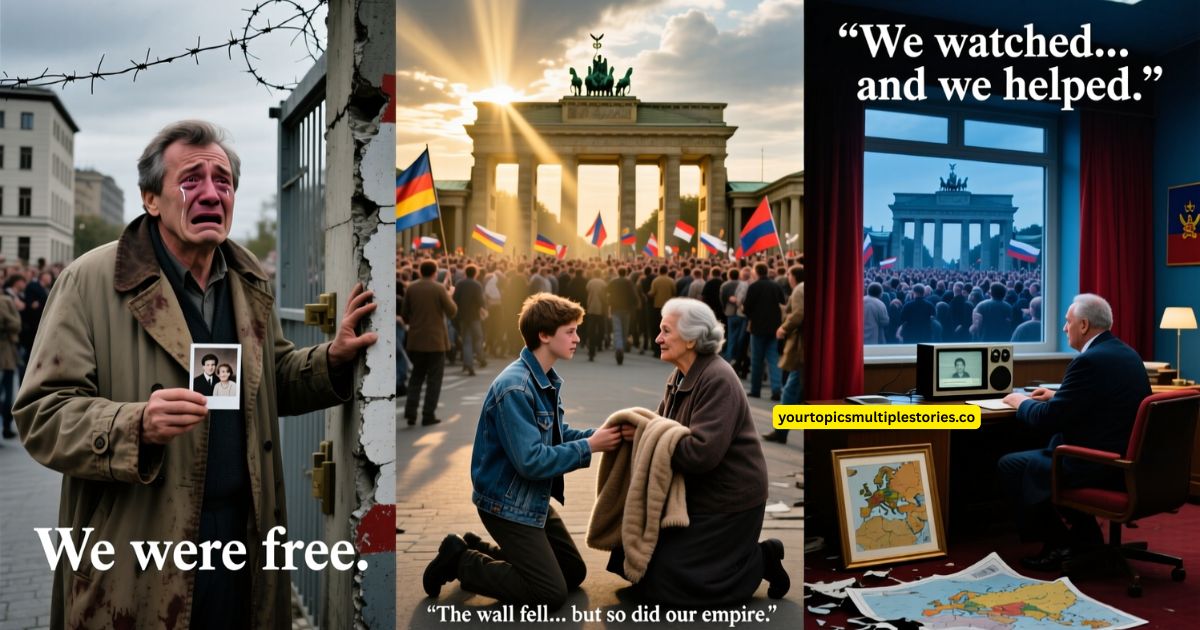
When the Berlin Wall came down, the world cheered for freedom. But the people there saw the moment very differently, depending on which side they were on.
The East Berliner's Story
East Berliners had lived under harsh rules for a long time. They were afraid of the secret police. The moment the Wall opened was pure joy. It meant freedom and a chance to live life without fear. It was a very big, happy change in their daily lives.
The West Berliner's Story
West Berliners watched the Wall fall from the outside. They were happy and gave money and help to their neighbors from the East. Their story is about caring for others and seeing a painful wall disappear. It was wonderful, but their lives did not change as much as the lives of those in the East.
The Soviet Leaders' Story
The Soviet Leaders felt fear and shame. The Wall's fall meant they were losing power in Europe. It was a big failure for their country. They decided not to use force, which meant the Soviet Union itself would soon fall apart.
The Titanic Sinking (1912): Money, Doors, and Engines
When the great ship Titanic sank, your social class—how much money you had—decided if you lived or died.
The First-Class Passenger’s Story
First-Class Passengers talked about being brave and letting others go first. Many rich men followed the rule of "women and children first." This story sounds noble, but it sometimes covered up the fact that rich people had better access to the lifeboats.
The Steerage Passenger’s Story
Steerage (Third-Class) Passengers lived in the lower parts of the ship. They found that gates and doors were locked. This made it hard to reach the lifeboats. Their story is about chaos and being treated unfairly because they were poor, even when facing death.
The Crew and Engineer’s Story
The Crew and Engineers saw the sinking as a technical disaster. They stayed below deck, trying to keep the lights on and the engines running as long as possible. Their story is one of duty, trying to fix a huge technical problem until the very end.
The Cuban Missile Crisis (1962): Big Fight, Small Island
The Cuban Missile Crisis was the moment the world came closest to a nuclear war. It is often seen as a fight between two big nations, but there was a third country that faced the biggest danger.
The US Leaders' Story
US Leaders felt a great burden. President Kennedy and his team worked hard to be strong but not start a war. Their story is about using smart planning to make the Soviet Union take their missiles out of Cuba. They felt they had saved the world.
The Soviet Leaders' Story
Soviet Leaders saw their move as needed to protect their country. They put missiles in Cuba to balance out the US missiles in Turkey. Their story is about a tense gamble. When they took the missiles out, they said they did it for world peace, getting the US to promise not to attack Cuba.
The Cuban Citizen’s Story
Cuban Citizens were living right in the middle of the danger. Their story is one of deep fear and not having any power. They worried about an American invasion and a nuclear bomb hitting their island. They were just people caught in a fight between giants.
The Partition of India (1947): New Homes, Huge Pain
The split of India into two countries—India and Pakistan—caused terrible violence and one of the largest moves of people in history. This event still hurts South Asia today.
The British Official’s Story
The British Officials felt they had a tough, urgent job. They had to draw a line to split the huge country quickly. Their story focuses on the difficulty of the work and the tight deadline. They did not fully see or take the blame for the massive violence that their hurried border caused.
The Muslim Migrant’s Story
For Muslim migrants traveling to the new country of Pakistan, their journey was a desperate flight toward a promised land. Their story is one of terrible loss—leaving homes, family, and land—and the difficult birth of a new nation.
The Sikh and Hindu Migrant’s Story
Sikh and Hindu migrants traveled the other way, toward India. Their story is also about being forced to leave their ancient homes. They faced religious attacks and the heartbreak of abandoning their land forever. Both migrant groups were victims of a political choice, but their memories are shaped by their new national identity.
The Suez Crisis (1956): Taking Back Control
The Suez Crisis proved that old powers like Britain and France were no longer the biggest in the world. It showed that the US and the Soviet Union now ruled the world stage.
Egyptian Nationalist Story
For Egyptian Nationalists, led by President Gamal Abdel Nasser, this was a great win for their country. Taking control of the Suez Canal was seen as taking back what was theirs from the hands of the former rulers (Britain and France). Their story is one of a brave victory against old colonial powers.
British/French Imperial Story
The British and French leaders tried hard to hold onto their power. They saw the Canal as vital for trade. Their secret military attack was meant to protect their money interests. Their later failure, forced by the US to leave, showed them their time as world leaders was over.
US/Soviet Story
The US and the Soviet Union used this moment to show their power. The US opposed the old-fashioned attack, proving itself as the new, main global leader. They used their money and political strength to force Britain and France to leave, changing the world's power structure.
The 1969 Moon Landing: Science, Flag, and Cost
The trip to the Moon was an amazing achievement for people everywhere, but it meant different things depending on who you were.
The NASA Scientist’s Story
For the NASA Scientists and Astronauts, the Moon Landing was the highest point of science. Their story is a celebration of human skill, hard work, and achieving a goal that seemed impossible. It was a victory for technology and human dreams.
The American Public’s Story
For most Americans, the landing was a moment of national pride. It was a victory over the Soviet Union in the Cold War "space race." The event proved that the American way of life was the best.
The Global Citizen’s Story (Poor Nations)
People in poor nations often felt two things. They were amazed by the science, but they also wondered about the cost. Their story raised a question: Why spend so much money on the Moon when there was so much poverty, hunger, and sickness on Earth?
Read: Must-Read: Top Blog Content Ideas for 2026
The Big Idea: History Needs All the Stories
Looking at historical events told through multiple perspectives changes how we see the past. It makes us realize that history is not a simple list of facts. It is many stories mixed together. By looking for all voices, we learn to understand the complicated reasons why people act the way they do. To understand history, we need to be curious, feel empathy, and accept that there are always many sides to every event. It is in these different stories that we find the most complete truth about the past.
Which story from these seven events changed your mind the most?
We cover history and other multiple stories daily on our homepage! (https://yourtopicsmultiplestories.co/).
Simple Questions: History and Memory
Can we ever find one, perfect historical truth?
No, a perfect historical truth is not possible. All history is told by people with their own beliefs and backgrounds. The job of a historian is not to find one simple truth, but to gather all the different stories and facts to create the clearest, fairest picture possible.
Which people's stories are often left out of history books?
The stories that are most often missing are those of people who did not have much power. This includes women, native peoples, slaves, poor workers, and children. We have to look hard for their stories in old letters, songs, and objects.
What is the difference between "history" and "memory" for a nation?
History is the serious, academic study of the past using facts and documents. Memory is the way a group of people remembers the past. Memory is often emotional, it chooses what it wants to remember, and it is shaped by what a nation needs today. For example, the North and South of the US have different "memories" of the Civil War.