How We Organize Our Blog: A System for Managing Multiple Topics Successfully
 Jeffrey S. Allen
The dream of covering diverse, fascinating topics on one blog often clashes with the reality of content chaos. Juggling articles on travel, finance, and technology can quickly lead to an overwhelming editorial calendar, diluted SEO authority, and a confused audience. Without a robust system, your valuable content risks becoming an unorganized mess.
We know this struggle intimately. This article is not a theoretical overview; it's a practical, expert-level guide detailing the exact framework we use to successfully Organize Our Blog and master the challenge of Managing Multiple Topics.
Our system relies on three pillars: Pillar Content Architecture, Precise Content Taxonomy, and a Strict Editorial Workflow. By adopting this structured approach, you can transform your diverse subject matter into a powerful, authoritative content library.
Discover our curated content structure at yourtopicsmultiplestories.co/.
Main Topic Structure: The 'Pillar Content' Idea for Many Topics
The best way to Sort Our Blog when dealing with many different subjects is to use the Pillar Content Model. Think of this as Topic Clusters. This way of building your site is key to long-term success when you cover a wide range of niches.
What the Structure Means
-
Pillar Content (The Core): This is a long, complete, and highly trusted guide (usually over 3,000 words). It covers one big, important keyword that many people search for. It’s the main, deep resource on that topic.
-
Cluster Content (The Support): These are shorter, more focused articles (500–2,000 words) that explore a small part of the main Pillar topic. They aim for specific, long-tail keywords. Crucially, every single Cluster article must link back to its main Pillar page.
Seeing Your Different Main Topics
Imagine your whole blog is a giant bicycle wheel. The center is your brand, but each major, different subject you cover is its own separate Pillar.
| Diverse Topic (Pillar Page) | Example High-Search Keyword | Supporting Article Examples (Cluster Content) |
| Pillar 1: Fun Travels | "Best Ways to Travel Green" | "Light Bags for Long Trips," "Saving Money for Travel," "Cool Hikes in Europe." |
| Pillar 2: Personal Money | "Saving for Retirement Made Easy" | "What is a Roth IRA?," "Simple Steps to Pay Off Debt," "How to Calculate Your Wealth." |
| Pillar 3: Content Plans | "Handling Many Topics Blog Guide" | "Checklist for New Articles," "How to Review Old Content," "The Easiest Content Calendar System." |
This structure makes authority build up vertically. When you publish a new article (Cluster), it links up to the main Pillar, making the Pillar more powerful. This simple, focused linking stops your content from spreading out too much and helps you get better results with search engines for all your different topics.
Picking Your Categories and Tags Smartly (The Naming System)
The term Content Taxonomy just means the set of rules you use to name and group your content. Having bad names and groups is the number one reason blogs become a mess, confusing both the people reading and the search engines trying to figure out your site.
The Big Difference: Categories vs. Tags
| Feature | Categories | Tags |
| Goal | Broad groups, like the main chapters in a book. | Specific, descriptive words, like an index in the back. |
| How Many | Limited (5 to 7 maximum). They should be big, timeless topics. | Flexible and numerous, used for cross-referencing. |
| Use | Every post must fit into one main category. | A post can have a few relevant tags (2–5 is best). |
| SEO Focus | Main topics that build overall site trust. | Help with internal linking and finding related content. |
Simple Checklist for a Clear Naming System
-
Name Core Categories: Base these on your main Pillars (e.g., Travel, Finance, Writing). Don't make a category for every tiny topic.
-
Keep Them Separate: Categories should not overlap. An article should only belong in one major group.
-
Treat Categories as Main Pages: Make sure your Category pages are easy for search engines to find and give a great experience to the reader (e.g., add a short intro paragraph).
-
Use Tags Sparingly: Tags should be specific actions, concepts, or tools (e.g., Using Google, Saving Money, Working From Home). Never use a tag that is the same as a category.
Simple Tip: If you have more than 7 main categories, your blog is likely trying to cover too much ground. This hurts your goal of Handling Many Topics effectively. You should combine some of them right away.
Our Weekly Work Plan: From Idea to Published Post
A clear Editorial Workflow is the engine that takes your big idea (Pillars) and your good organization (Naming System) and turns them into high-quality posts, week after week. This step-by-step process makes sure everyone knows what they need to do and keeps things moving smoothly.
We use a four-day writing week. This lets us focus on specific tasks each day and avoids the time-wasting habit of switching between different types of work.
The 5-Step Plan for Getting Things Done
| Step | Day(s) | Focus and Detail |
| 1. Find Ideas and Research | Monday (Morning) | Gather: Look at reader feedback, check what other sites are doing, and review keyword reports from SEO tools. Group: Decide on the specific Pillar, Cluster, and Category for the week’s articles. |
| 2. Create Outline and Get Approval | Monday (Afternoon) | Make a full outline (main points, sub-points, goal word count, internal links) for the assigned article. Getting approval is a must before any writing starts. |
| 3. Write the First Draft | Tuesday - Wednesday | The writer's main job. No editing, no SEO work—just focused writing based on the approved outline. Drafts must be finished by Wednesday evening. |
| 4. Edit, SEO, and Pictures | Thursday (Morning) | Editor checks for clear language, right tone, and grammar. SEO Expert adds final tweaks, titles, and image descriptions. Pictures and graphics are made ready. |
| 5. Schedule and Share | Thursday (Afternoon) | The finished article is put into the website system, set to go live (e.g., Friday morning), and the Content Calendar System is updated. The plan for sharing (social media, email) is carried out. |
The Tools We Use for Scheduling and Tracking
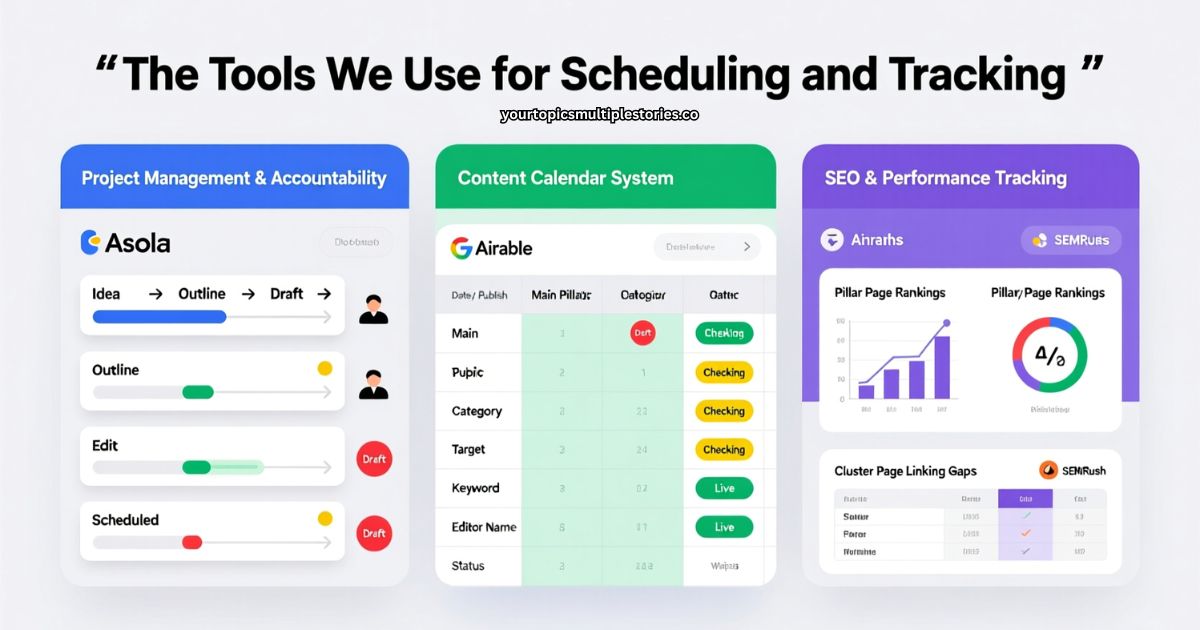
You can't manage a large, varied content library well without the right digital setup. The key is to have tools that work together clearly. Our system uses three kinds of tools.
1. Project Management & Accountability (Trello/Asana)
We use a simple board (like Trello or Asana) to see where every article is in the process. Each article is a "card" that moves through the 5 steps (Idea $\to$ Outline $\to$ Draft $\to$ Edit $\to$ Scheduled). This stops work from getting stuck and makes sure the team knows who is responsible for the next step.
2. The Content Calendar System (Google Sheets/Airtable)
While a project manager tracks the status, a separate Google Sheet or Airtable base tracks the schedule and results. This is the core of our plan for Managing Multiple Topics.
Must-Have Calendar Fields:
-
Date to Publish (Set)
-
Main Pillar Topic
-
Main Category
-
Target Keyword
-
Writer/Editor Name
-
Status (Draft/Checking/Live)
3. SEO and Performance Tracking (Ahrefs/SEMRush)
These tools are essential for checking how our structure is working. We track how well our main Pillar Pages are ranking and find Cluster Pages that aren't linking back or getting enough visits. This information goes right back into Step 1 of our work plan.
Read: Why Telling a Good Story is Key to Top-Ranking Blog Content (The SEO Secret)
Checking and Deleting Old Content for Better Results
A big danger for a blog that is Handling Many Topics is keeping too much old, poor, or irrelevant content. A regular Content Audit (review) is needed to keep your site trusted and your efforts focused.
The Content Review: R-U-P Method
The goal of the review is simple: find content that is hurting your site (low visitors, people leave quickly) and decide what to do with it. We use the R-U-P method:
-
Refresh (R): For articles that are still important but old (e.g., reviews of tools, statistics). The update should add current facts and re-optimize the post.
-
Update/Merge (U): For articles that are on a related but very small subtopic. These are often combined into one bigger, better Cluster article to make that article stronger. The old, small page is deleted and redirected (301 redirect).
-
Prune/Delete (P): For articles that are not important, poor quality, or totally out of date with no valuable visits. Deleting truly bad content and adding a 410 (Content Gone) or a 301 to the category page clearly tells Google that your site only keeps high-quality material.
Result: By deleting or combining bad-performing articles, you focus your site's power and search engine time on your best pages (your Pillars and Clusters). This greatly improves your overall site's trust when Handling Many Topics.
Final Thoughts
Successfully Sorting Our Blog while covering many topics is not about writing more; it’s about writing smarter inside a strict, repeated framework. By using the Pillar Content Model, setting up clear Content Taxonomy, and following a firm Editorial Workflow, you get rid of the mess and build real expertise in your subjects.
This simple system makes sure every new article helps a goal you already set, making your content plan easy to grow and maintain.
We encourage you to try the Pillar Content Model for your main topic this week. Create one main guide and outline three supporting articles right away.
Explore the success of our simple approach at yourtopicsmultiplestories.co/.
Simple Questions Answered (FAQs)
How many categories should a blog with many topics have?
We strongly suggest keeping your main categories to 5 to 7 at the most. Categories are the foundation of your site. If you have more than 7, your content plan is probably too spread out. Focus on big, clear themes that match your main Pillars.
How often should I check my old content?
A full, deep Content Audit using the R-U-P method should be done at least once every 9 to 12 months. However, we quickly review the 20 best and 20 worst performing pages (by visitor count) every three months to catch issues or quick wins.
What is the biggest mistake when Handling Many Topics?
The biggest and most harmful mistake is Keyword Cannibalization. This happens when two or more articles (often in different categories) try to rank for the exact same main keyword. This confuses search engines and makes your own articles fight each other. The Pillar Content Model solves this by clearly defining which keyword belongs to which specific article (Pillar or Cluster).
Should every blog post have a link to another page on my site?
Yes, definitely. Every supporting Cluster post must link to its main Pillar page, and ideally to 2–3 other related Cluster articles. Internal linking is the digital form of organization and is absolutely necessary for building trust when Handling Many Topics.