The Psychology of Why We Love Reading Many Different Topics (Learning & New Ideas)
 Jeffrey S. Allen
The internet is a vast, hyper-specialized landscape. For every general news site, there are ten thousand blogs dedicated solely to, say, artisanal coffee brewing, niche cryptocurrency trends, or the specific history of 18th-century French teacups. While hyper-niche content serves a dedicated few, it often leaves the majority of readers with a feeling of intellectual stagnation. They quickly master the small pool of content and then grow bored.
Why does the modern reader, bombarded with infinite choice, consistently gravitate toward content that covers everything from astrophysics to ancient history? The answer lies not just in a fleeting interest, but in the fundamental wiring of the human brain. The enduring appeal of generalist content—content that is interdisciplinary, eclectic, and unpredictable—is a powerful testament to our core curiosity drive and its profound cognitive benefits.
This article delves into the psychology behind why people love reading diverse topics, exploring the scientific theories that explain why a generalist diet of information is not just entertaining, but critical for mental agility and sustained engagement. It’s an intellectual feast, and the brain is the ultimate diner.
To begin your journey into the vast and varied world of knowledge, explore all kinds of narratives under your topics (https://yourtopicsmultiplestories.co/).
The Brain's Quick Reward for Newness (Novelty Bias)
At the core of the brain’s love for reading many topics is the Novelty Bias. This is a known habit of the mind and a biological fact: the human brain is naturally set up to look for new facts and new experiences. Newness is a powerful signal of reward.
When we find information that is truly novel—something we hadn't thought about or seen before—it causes a burst of dopamine. This happens deep in the brain, in areas tied to pleasure and motivation. Dopamine is the same chemical messenger linked to feeling good, wanting more, and being addicted.
-
The Unpredictable Reward System: Diverse content gives the brain a constant, surprising flow of small rewards. Reading three articles in a row about the exact same topic gives less and less pleasure. The reward becomes expected, and the dopamine release slows down. But an article about new computers, followed by one on old Roman buildings, and then one on modern farming, offers a surprise reward schedule. Each new topic is a fresh trigger. This keeps the reader interested and the website very engaging.
-
A Way to Survive: From a long time ago, seeking new things was key to staying alive. It pushed early humans to explore new places, find new foods, and learn about dangers. This old way of thinking is used today: our brains reward us for looking for diverse knowledge. We know, without thinking, that this helps us solve problems better and change with the times.
The steady, small rush of dopamine from generalist content is one of the strongest psychological reasons why people love reading many different topics. It makes learning and taking in information a truly enjoyable and motivating activity.
Reading Many Topics Helps Your Brain Think Better
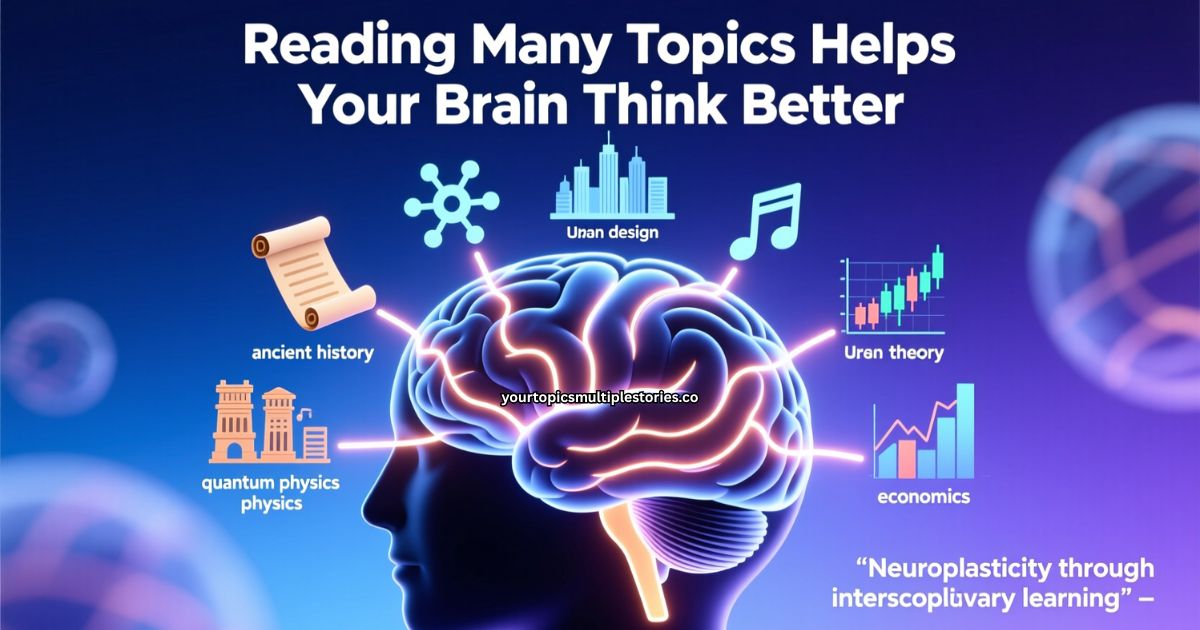
Reading widely is more than just fun; it's a powerful exercise for your mind. When we read diverse, interdisciplinary content, we force our brains to create new connections between different areas of knowledge. This process is what fuels creativity.
The brain works through associative learning. New information is always processed by linking it to what you already know. When a topic is completely new, the brain struggles to connect it. When two subjects that were not connected before are shown one after the other (for example, an article linking the physics of water flow to the flow of money markets), the brain must build a bridge between them.
- Building and Strengthening Brain Links: Reading diverse information improves neuroplasticity—the brain’s ability to change by making new connections. Looking at ideas from fields you rarely touch (like history and technology) helps grow new pathways and strengthens the links between different parts of the mind.
-
Better Problem-Solving: Truly new ways to solve problems rarely come from knowing one thing deeply. They come from using an idea from one field to fix a challenge in another. For example, understanding a supply plan from military history might inspire a solution for running a modern business. This cognitive benefit is why many top leaders and business people make interdisciplinary content a main part of their learning. By constantly connecting diverse ideas, generalists build a large, linked mental library. This makes creative leaps and thinking sideways much easier to do.
Using Variety to Fight 'Tiredness from Choosing'
In this time of endless scrolling and custom computer programs, one of the biggest mental burdens on the modern reader is Decision Fatigue. This idea first described the strain of making many choices in life (like why some famous people wear the same clothes to save their “choice energy” for bigger things). It is very true for reading digital content.
Every time a reader finishes an article, they face a small choice: What should I read next? Should they click on something like the last article, or try a new topic? This constant, small effort of looking through so much content is quietly tiring.
This is where a trusted source of Generalist Content steps in to solve a major mental problem. A good generalist site takes away the mental load of choosing by giving you a well-picked, diverse, and consistently good set of topics.
-
The Trusted Guide: The reader trusts the publication to pick their next topic for them. They hand off the “What should I learn?” decision. This saves their limited mental energy. They can just enjoy the content without the effort of constant searching.
-
Easy Mental Boost: The reader gets the high reward of newness (as we talked about) without having to find it themselves. They can jump from science to art to philosophy, all on one site. This easily meets their need for mental activity while helping them avoid the drain of making decisions. This ease of use is a powerful, often ignored, reason for the appeal of diverse content.
The 'Curiosity Drive' and The Gap in Information
The most basic human need that drives us to read diverse information is the Curiosity Drive. We are built to be curious. This drive is best explained by the psychologist George Loewenstein’s Information Gap Theory.
This idea says that curiosity is not just a general wish to know. It is a very specific, uncomfortable feeling that pops up when a person notices a gap between what they know and what they want to know. It is an itch that must be scratched.
-
The Perfect Gaps to Engage: Diverse content is perfectly designed to start this process. By showing a wide range of subjects, a generalist site constantly points out small but tempting gaps in a reader's knowledge. An article about ancient writing might share a small, interesting fact the reader did not know. This instantly creates a gap in information, which starts the curiosity drive to learn more about connected topics.
-
The Power of Small Reveals: The key is that the gap must be the right size—not so huge that the topic feels too big and not important, but not so small that it is already known. Diverse, high-quality content does this by giving engaging, high-level summaries of new fields. It gives just enough information to make the reader see a gap and feel a strong push to find out more. This inner pressure is the "want" that leads to reading.
Real Example: The Success of General Publications
The big and lasting success of generalist publications proves these psychological ideas are true in the real world.
Think about a magazine like National Geographic. While their name is tied to nature and travel, their articles cover a huge range: deep history, environment, cultures, new technology, and photos of animals. Their success comes directly from feeding the brain's need for new ideas and connections between topics. Every issue gives a fresh, surprising, and very rewarding mix of topics. This keeps the dopamine flowing and gives the most cognitive benefits.
In the same way, publications like The Atlantic or popular mixed-topic forums succeed because they act as trusted guides, solving the decision fatigue problem. Readers know they can trust the quality, even if the next article is about a completely different subject. They satisfy the curiosity drive by offering great content that consistently points out those perfect information gaps. The generalist model is not just a content choice; it is a smart psychological strategy.
Conclusion
The psychology behind why people love reading many different topics is clear: it’s not just a choice; it’s a mental need.
Reading diverse content is driven by three strong mental advantages:
-
Newness: The dopamine-fueled reward system keeps us interested in the surprising mental boost.
-
Learning: The forced mixing of interdisciplinary content strengthens brain connections and boosts creativity.
-
Ease: The trusted curation fights decision fatigue, making the whole process easy.
In the end, the generalist reader is a better, more creative thinker. They constantly give their mind the diverse input it needs to do well in a complex, connected world.
What is one thought-provoking, diverse topic you’ve recently learned about? Find more thought-provoking multiple stories here! (https://yourtopicsmultiplestories.co/).
FAQs (Common Questions)
Is the need for newness always helpful?
While the need for newness is a strong reason for learning and exploring, it is not always helpful. When buying things, it can make people constantly buy the newest gadget, even if their old one works fine. When reading, it can lead to "intellectual skimming," where a reader jumps too fast between topics without learning any one area deeply. A good mental diet balances looking for new things with focused, deep study.
How does being curious help you remember things?
Curiosity greatly improves memory through a process called dopamine-aided memory. When the curiosity drive starts (when there is an information gap), the dopamine released in the brain acts as a powerful memory booster. Studies show that information learned while a person is curious is remembered better. Even more surprising, unrelated information shown right after the moment of curiosity is also kept better in memory. This means being curious makes the entire brain ready for better learning.
Is reading many topics a sign of knowing a little about everything?
The old saying "jack-of-all-trades" often means someone who is not good at anything ("master of none"). However, in the complex world today, the "generalist" or the reader of interdisciplinary content is better described as a "T-shaped person." This is someone with deep knowledge in one or two areas (the tall line of the T) and wide, varied knowledge across many others (the crossbar of the T). This wide base of knowledge, built by reading many topics, is what allows for greater new ideas, better talking between different teams, and better sideways problem-solving. It is a highly valued mental skill.
Does reading diverse content help reduce tiredness from choosing in other parts of life?
Yes, in a small way. By letting a trusted generalist source choose "What to read next?" the reader saves a tiny bit of mental energy that would have been used for searching. While saving one choice is small, the total effect of reducing micro-decisions over time can help the brain feel slightly less tired. This means there is more mental energy left for important choices in personal or work life. The main benefit is reducing content fatigue, but the small side benefit on general choosing ability is likely.