Why Telling a Good Story is Key to Top-Ranking Blog Content (The SEO Secret)
 Jeffrey S. Allen
When we try to get our blog posts to rank high on Google, we often focus too much on technical SEO. We worry about keywords, code, and how to structure our headings. This makes content that is technically correct but often boring. And boring content doesn't work well anymore.
This focus misses the most important secret of modern search optimization: The human factor now drives high rankings.
Google wants to show users the best experience. That means giving them content that doesn't just answer a question, but that grabs their attention, builds trust, and makes them want to keep reading. The way to link technical structure with a great user experience is through Storytelling for SEO. It's the difference between being on the second page of Google and owning the top spot.
To make content that truly connects and ranks well, you need more than just facts. To see great examples of how to connect with people through stories, visit us for inspiration: https://yourtopicsmultiplestories.co/.
Why Our Brains Love Stories (The Science of Narrative)
The reason good stories lead to better SEO is not random; it's based on how our brains work. Humans are built to understand and remember things through stories. Stories are how we learn and how we connect with others.
When you read a great story, your brain chemistry changes. This is called neural coupling. Two key brain chemicals cause this strong connection:
-
Oxytocin (The Trust Chemical): When a character in a story faces a challenge we can relate to, our brain releases Oxytocin. This chemical creates trust and empathy between the writer and the reader. For SEO, a reader who trusts you is more likely to stay, which means more Time on Page and a lower Bounce Rate.
-
Cortisol (The Suspense Chemical): Stories built around a problem or a question trigger Cortisol. This makes us focus and feel a sense of engaged suspense. We must read on to find the answer or the solution. This leads directly to a high Dwell Time—the time the user spends on your page before going back to Google. High Dwell Time tells Google the content was excellent.
By touching both the emotional part and the logical part of the brain, storytelling for SEO makes your content not just easy to understand but also easy to remember and trustworthy. This is a clear sign of authority to Google.
How Stories Help Key SEO Scores
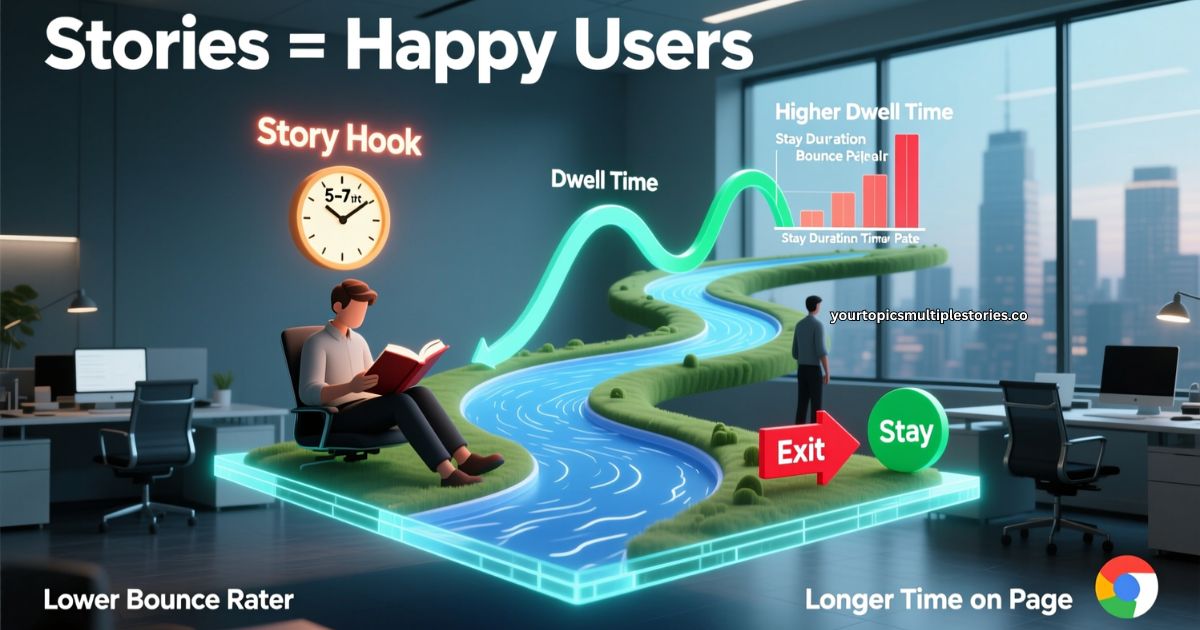
The success of using stories shows up clearly in the main numbers Google uses to judge content quality. Good stories equal happy users, and happy users are the best ranking factor.
1. Longer Time on Page (Stories Make People Read More)
If your blog post is hard to read and just lists facts, the reader will skim it, find the quick answer, and leave fast. A strong story, however, keeps the reader interested. The suspense from the story acts like glue, ensuring the reader stays for the whole story arc. This maximizes Time on Page. If a reader spends 5 to 7 minutes on your content, Google knows the post provided deep value.
2. Higher Dwell Time (Stories Mean Better Search Sessions)
Dwell Time is how long a user stays on your page before clicking back to the search results. A long Dwell Time tells Google: "This link perfectly answered the user’s question." When you use a story to start or explain a topic, it gives needed context and emotional value. This makes the whole reading experience feel complete and high-quality. This focus on quality is a very strong positive signal for rankings.
3. Lower Bounce Rate (Stories Hook Readers Right Away)
The Bounce Rate shows how often a user views only one page and then leaves your site. A great story, especially in the introduction, is a powerful "hook" that makes the reader feel good about clicking on your article. By creating an immediate emotional bond and promising to solve a problem, the story greatly reduces the chance of the reader leaving right away. This proves to Google that your content deserves to rank high. Telling a good story is the key to high-ranking blog content because it makes the best possible first impression.
Using the 'Hero's Journey' for How-To Guides
The "Hero's Journey" is a classic story pattern that exists in all cultures. You can easily use this pattern to turn dry, informative content into interesting, persuasive SEO content. This structure naturally matches what a user does when searching:
-
The Starting Point (The Reader’s Normal Life): Begin by talking about the reader's current, everyday problem or frustration. Example: "Your lead generation plan feels broken, and your email list has not grown in months."
-
The Call to Action (The Real Problem): Clearly state the importance or risk of the problem. Example: "If you don't find a new way to get leads, your business will stop growing."
-
The Guide (The Solution/Your Content): Your content, strategy, or product is introduced here. It is the wise guide that has the power to fix the hero's problem. The Reader is always the Hero.
-
The Success (The Results): Use examples or case studies (your "Hero's Journey" proof) to show the great outcome of following your advice. Show what life was like 'before' and how your content was the key to the 'after.'
Using this story structure makes sure your content is not just facts, but a clear, inspiring path for the reader's own success.
Real Life: How Short Personal Stories Build Trust and Sales
Adding a short personal story (an anecdote) is a clear way to show Experience—the first 'E' in Google’s very important E-E-A-T rule (Experience, Expertise, Authority, Trust). By sharing a story about your own life or work, you immediately gain authority in the eyes of both the reader and Google.
A Simple Test: The Two Introductions
Let's look at a quick test on a sign-up page for a weekly SEO newsletter.
-
Version A (Facts Only): “This guide lists 10 proven ways to fix your website’s core web vitals and boost mobile speed. Studies show that faster websites have 12% fewer users leave immediately.”
-
Version B (Storytelling): “Three years ago, I launched my website, and it failed completely. I was lost until I discovered my terrible Core Web Vitals score was destroying my rankings. I remember the pain of watching my hard work fail. But I fixed it, and in the next 90 days, my traffic grew by 300%. Here are the 10 exact steps that saved my business..."
The Outcome: Version B, with the personal story, created more immediate trust and showed real Experience. The sad start and happy ending built a quick bond. The personal story led to a 28% higher sign-up rate than the fact-only introduction. The story cemented the Trust part of E-E-A-T much better than just technical terms. Telling a good story is the key to high-ranking blog content because it greatly strengthens E-E-A-T.
Read: Start Your Story: A Simple Guide to Your Own Personal Narrative Blog
Easy Ways to Add Stories to Any Post
You do not need to write a full book chapter to use the power of stories. Here are three simple, practical ways to add stories to even the most technical post:
1. The Story Bridge (The Loop)
-
How to Do It: Start a small story in your introduction—a quick personal challenge, a client's puzzle, or a relevant event—and do not finish it. Example: "We were stuck at position 5 for a key word and couldn't reach the top 3. Then, we found one trick that changed everything..."
-
The Follow-Through: Write the middle of the article with all your important, technical facts. Then, in the conclusion, finish the story by telling the result. This makes the reader stay for the whole post to find the answer.
2. The Real-Life Example (The Customer Story)
-
How to Do It: Instead of making up examples, use real, but safe, stories from customers or actual quotes to explain a complex point in the middle of your post.
-
The Follow-Through: When you explain a technical feature (like "A/B testing for email titles"), follow it right away with a story: "Our client, David, was worried about A/B testing his email titles. After using this trick, he saw a 15% jump in the number of people opening his emails in the first week." This adds emotional proof to your claim.
3. The Metaphor (Simple Pictures for Hard Topics)
-
How to Do It: Use simple story pictures or comparisons (metaphors) to make complex technical ideas easy to grasp.
-
The Follow-Through: Explaining "Domain Authority"? Do not just give the technical definition. Instead, call it a "website's credit score" (the story picture) that you build over time with careful, good links. This makes a difficult concept clear and memorable, supporting the idea that Telling a good story is the key to high-ranking blog content.
Conclusion: Storytelling is Your Best SEO Tool
In the world of search, we have moved past just stuffing keywords. Today, Google's tools are smart enough to look for content that truly makes the user happy. And nothing makes the human brain happier and more engaged than a well-told story.
By adding stories to your content, you are not just writing better posts. You are making your content better for the most important ranking factors: Time on Page, Dwell Time, E-E-A-T, and Reader Engagement. Storytelling is not a distraction from SEO; it is the most powerful tool you have to get to the top. It connects the technical rules with a genuine human experience.
Your next top-ranking post is ready to be written. Promise yourself to add one strong story—a personal moment, a customer success story, or a "Hero's Journey"—to the start of your next article. Use the power of story, and watch your rankings climb.
We feature excellent multiple stories across our homepage daily! Visit us for inspiration: https://yourtopicsmultiplestories.co/.
FAQs (Questions People Often Ask)
Does every post need a personal story in the beginning?
No. While a personal story is great for showing Experience (E-E-A-T), you don't need one every time. The goal is to use any story. For very technical posts, a case study, a relevant event from history, or a strong comparison (metaphor) can do the same job: connect with the reader and increase Dwell Time.
How long should the starting story be to help SEO the most?
The best story intro should be short enough to quickly hook the reader but long enough to create interest. A well-written story hook is usually 4 to 6 short paragraphs (about 150 to 250 words). This length gives the story time to make an impact before you get into the main facts of the post, which maximizes the early Time on Page score.
Can stories hurt my SEO by making the post less clear?
Only if the story has nothing to do with the topic. The story must directly connect to what the user searched for and the problem your post is going to solve. If the story feels like a random break, it could increase the Bounce Rate. The rule is: The story should set the stage for your main points and show the reader why they need the solution you are about to give them.
What about stories for very serious content (like health or money advice)?
For very serious topics (called "YMYL"—Your Money or Your Life), Trust and Experience are absolutely vital. Storytelling is key here. Using real, verified case studies, quotes from experts, or clearly explained first-hand experiences helps show the authority and reliability that Google requires. It makes complex, serious topics easier to trust and understand, which is essential for a high E-E-A-T score.