The Ultimate Checklist for Editing and Polishing Your Blog Post (30+ Points)
 Jeffrey S. Allen
Publishing a blog post without editing is risky. Small mistakes can slip in. Sentences may feel confusing. SEO chances can be lost. Most of all, readers may stop trusting your content.
If you are a blogger, content writer, or editor, strong editing is a must. In the USA market, competition is tough, and quality matters.
This Ultimate Checklist for Editing and Polishing Your Blog Post gives you a clear, step-by-step system. It helps you fix errors, improve clarity, and prepare your post for publishing. Before sharing your work, take time to polish it the right way. Perfect your posts before sharing them with our your topics community: https://yourtopicsmultiplestories.co/.
You can use this guide as a Pre-Publish Checklist, a Proofreading Guide, and a full Content Polishing Quality Audit.
Phase 1: Structural Editing — Flow and Logic
(The Ultimate Checklist for Editing and Polishing Your Blog Post starts here)
Structural editing looks at the big picture. At this stage, you do not focus on grammar. You focus on meaning, order, and flow.
Phase 1 Checklist
- Does the introduction make a clear promise?
- Tell readers what they will learn.
- Explain the problem and the benefit.
- Avoid slow or unclear openings.
- Do the H2 sections follow a clear order?
- Each section should build on the last one.
- Move headings if ideas feel out of place.
- Remove sudden topic jumps.
- Does every section support the main goal?
- Each paragraph should help the reader.
- Remove content that does not add value.
- Does the conclusion summarize the H2 sections?
- Restate the main ideas simply.
- Remind readers what action to take.
- Is the tone the same throughout the post?
- Choose one tone and stick with it.
- Do not switch between formal and casual.
- Are there repeated or unnecessary sections?
- Combine similar ideas into one clear point.
- Remove extra explanations.
This phase helps your article pass a strong Quality Audit before fixing details.
Phase 2: Line Editing — Grammar, Clarity, and Voice
(A core step in the Ultimate Checklist for Editing and Polishing Your Blog Post)
Line editing improves how your ideas sound and feel. This step makes your writing clean, clear, and professional.
Phase 2 Checklist
- Fix spelling and grammar mistakes
- Use a grammar-check tool.
- Review changes carefully.
- Remove passive voice
- Use clear action words.
- Example:
- Weak: “The article was edited by the writer.”
- Strong: “The writer edited the article.”
- Replace weak verbs with strong ones
- Avoid words like is, was, have.
- Strong verbs make content feel alive.
- Delete filler words
- Remove words like just, very, really, maybe.
- Clear writing builds trust.
- Use one tense only
- Do not jump between past and present.
- Stay consistent.
- Shorten long sentences
- Break them into simple ideas.
- Aim for one main thought per sentence.
- Read each paragraph by itself
- Check if it still makes sense.
- Rewrite if it feels unclear.
This step works as a Readability Check and a practical Proofreading Guide.
Phase 3: SEO Optimization Check — The Technical Must-Haves
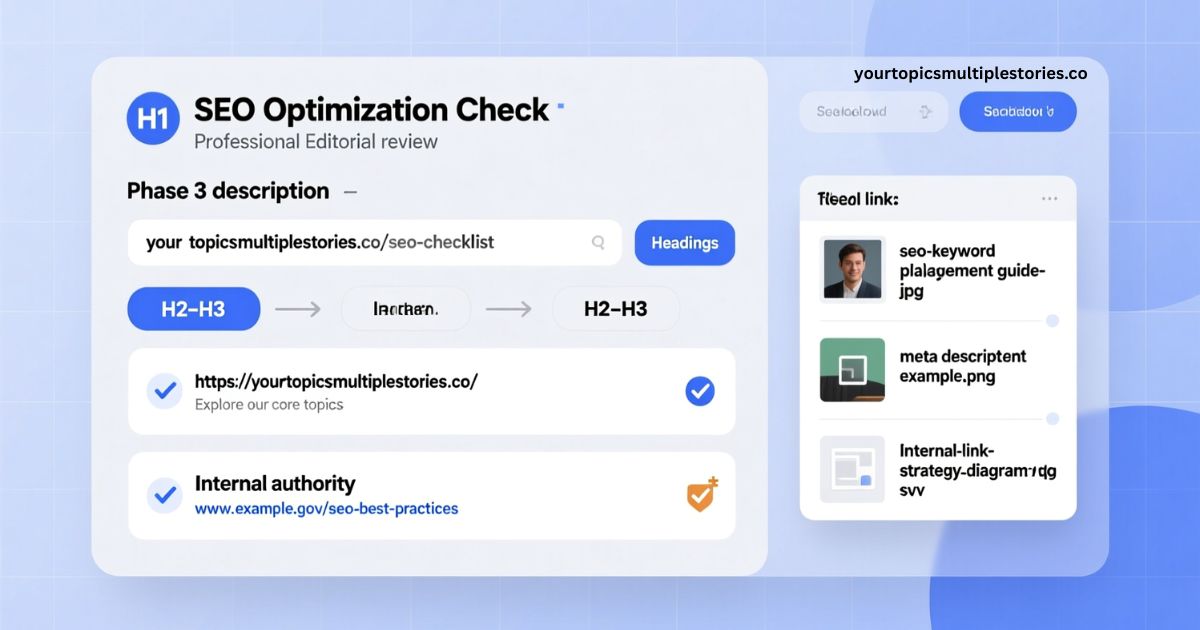
Good writing needs strong SEO. This SEO Final Check helps search engines understand your post.
Phase 3 Checklist
- Is the main keyword in the H1 and title tag?
- Use it in a natural way.
- Avoid keyword stuffing.
- Is the meta description under 160 characters?
- Make it clear and interesting.
- Focus on benefits, not summaries.
- Is the URL short and clear?
- Remove extra words.
- Keep it easy to read.
- Are keywords placed naturally in headings?
- Use them where they fit.
- Do not force them.
- Are there at least two internal links?
- One must link to https://yourtopicsmultiplestories.co/.
- Internal links help SEO and readers.
- Is there at least one external authority link?
- Link to a trusted source.
- This boosts credibility.
- Are image file names descriptive?
- Avoid random numbers.
- Use clear, related words.
SEO polishing helps your content get found and ranked.
Phase 4: Formatting and Readability — The Scan Test
Most readers scan before they read. If your post looks hard to read, they leave.
Phase 4 Checklist
- Are paragraphs short (3–4 sentences max)?
- Short paragraphs improve focus.
- Long blocks scare readers away.
- Is there enough white space?
- Space helps ideas stand out.
- Clean layout improves reading.
- Are lists clearly formatted?
- Use bullets or numbers.
- Avoid hidden lists in text.
- Are important points bolded?
- Highlight key ideas only.
- Do not overuse bold text.
- Is font size and spacing easy to read?
- Think about mobile users.
- Comfort matters.
- Does the post pass the 30-second scan test?
- Can readers get the main idea fast?
- If not, improve headings.
This step ensures your post feels friendly and clear.
Read: 7 Simple Steps to Get More Comments and Discussion on Your Blog Posts
The Final Review: Reading It Aloud and Image Check
This is the last step before you publish.
Final Review Checklist
- Read the post aloud
- You will hear awkward phrases.
- Fix anything that sounds odd.
- Check image speed
- Large images slow pages.
- Compress when needed.
- Add clear alt text to images
- Describe what the image shows.
- Helps accessibility and SEO.
- Test all links
- Click every internal and external link.
- Fix broken ones.
- Check mobile layout
- View the post on a phone.
- Make sure text and spacing look good.
This final pass keeps quality high and errors low.
Conclusion
Great content needs proper editing.
This Ultimate Checklist for Editing and Polishing Your Blog Post helps you:
- Fix structure and flow
- Improve clarity and grammar
- Optimize SEO
- Increase readability
- Avoid costly mistakes
Save this checklist and use it before publishing every post. Strong editing builds trust and long-term success.
Read more quality multiple stories on our site: https://yourtopicsmultiplestories.co/.
FAQs (Frequently Asked Questions)
How long should editing take?
Editing should take 30–50% of your writing time. Good content is shaped, not rushed.
Can AI replace human editing?
AI helps with basic errors, but humans are better for tone, flow, and meaning.
Should I edit right after writing?
No. Take a short break first. Fresh eyes catch more mistakes.
Is this checklist good for all blog types?
Yes. It works for blogs, guides, and long-form articles in any niche.